
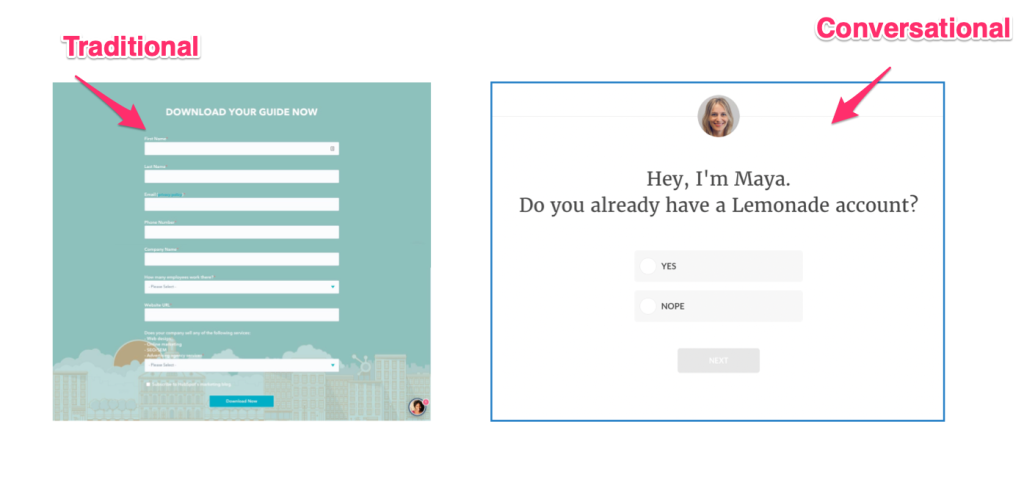
Last week We changed our lead gen page from traditional to Conversational forms by inspiring Lemonade and consistently achieve higher conversion rates than traditional forms by creating a more interactive, user-friendly, and personalized experience.
Why Conversational Forms Outperform
Conversational forms simulate a chat, asking users one question at a time, guiding them interactively instead of overwhelming them with a long, static list. This approach is less intimidating—users feel more like they’re engaged in a helpful dialogue.
-
Studies have shown up to 30–60% higher completion rates for conversational forms compared to traditional ones.
-
Traditional forms, especially when lengthy, have high abandonment rates—sometimes as much as 88%—because users find them tedious or confusing.
-
Conversational forms reduce cognitive load, making it easier for users to provide information step-by-step, boosting the likelihood of completion.
Engagement and User Experience
-
Traditional forms present all fields at once, which is efficient for structured data but dull and impersonal.
-
Conversational forms adapt dynamically, responding to user inputs, offering clarifying questions, and personalizing the flow based on answers. This dynamic logic makes users more likely to finish and submit.
-
Conversational formats are especially effective on mobile devices, as the simple, chat-based layout fits naturally on small screens and reduces scrolling hassles.
Data Quality and Business Value
-
Conversational forms enable richer data collection, as open-ended questions and clarifications are more natural in a dialogue.
-
Businesses using conversational forms get not only more leads but also deeper insights and higher-quality data, thanks to greater engagement and less form abandonment.
Versatility and Modern Application
-
Conversational forms can be deployed across multiple channels—websites, messaging platforms, and within chatbots. Their flexibility gives businesses more ways to engage users where they are most active.
-
Traditional forms still have advantages for very complex or regulatory-heavy processes but are being rapidly displaced by conversational approaches for lead generation, surveys, and onboarding.
In conclusion, conversational forms dramatically outperform traditional web forms in conversion and engagement. They feel more human, reduce friction, gather higher quality data, and are rapidly becoming the standard for any user-facing process where completion rates matter most.