
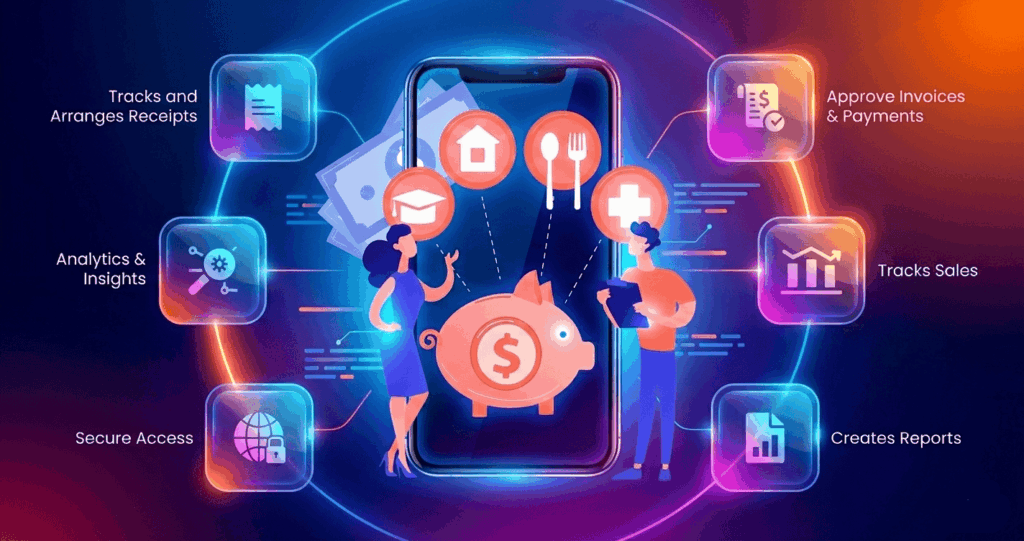
Expense Management Apps helps to manage expenses across multiple credit cards and bank accounts. Banks are unable to provide this service. Expense Manager has the ability to look at the entire financial profile of a user. With the introduction to credit, users can realize that good financial management can help them get credit also.
Expense management in Indian FinTech has evolved far beyond simple tracking – it now empowers users to proactively manage spending, access credit, and unlock stronger financial futures. Expense manager apps have outpaced banks by providing integrated, actionable financial insights across credit cards and bank accounts, and are redefining how Indians – especially new – to – credit or tech – savvy users – take charge of their money.
The Challenge: Fragmented Banking Services
Traditional banks in India have struggled with unified expense management. The problem is not just technological – it’s structural, cultural, and operational.
Banks only offer views into individual accounts or cards, lacking consolidated dashboards. If you have a savings account with HDFC, a credit card with ICICI, and a wallet with Paytm, there’s no single place where you can see your complete financial picture. Each institution operates in its own silo, forcing users to juggle multiple apps, passwords, and statements.
Integrated financial planning, analysis, and real – time notifications are typically absent from banking platforms. Most bank apps are transactional in nature – they let you check balance, transfer money, or pay bills – but they don’t tell you why you’re spending more this month, where your money is going, or how to optimize your finances.
New to credit users, teenagers, and even small business owners face difficulty, as banks’ underwriting depends solely on credit history and high transaction volumes. If you’re a college student with just a savings account and small monthly deposits, banks won’t even consider you for a credit card. If you’re a gig worker earning through multiple platforms but lacking formal salary slips, you’re practically invisible to traditional lending systems.
This gap – between what users need and what banks provide – is where FinTech expense managers have built their entire value proposition.
The FinTech Solution: Unified Expense Management
FinTech – led expense managers have filled this gap through smart aggregation and analysis. They’ve turned expense tracking from a passive, retrospective activity into an active, predictive tool for financial wellness.
Integration via Multiple Data Sources: Apps like Walnut, MoneyView and ET Money don’t wait for you to manually enter every expense. They fetch transactional data from SMS alerts sent by multiple banks and credit card issuers, automatically categorizing expenses and eliminating manual entry. Some advanced platforms also integrate with email receipts, UPI transaction logs, and even wallet APIs to create a comprehensive financial timeline.
Centralized View: Users see total balances and all transactions – across accounts, cards, wallets – in one interface for real – time tracking, budgeting, and control. Imagine opening one app and instantly knowing: “I have ₹45,000 across three bank accounts, ₹12,000 available credit across two cards, ₹3,500 in wallets, and I’ve already spent ₹18,000 this month on dining and entertainment.” That’s the power of consolidation.
Custom Reports & Alerts: High – spend warnings, bill reminders, and daily/weekly summaries provide accountability and support better financial habits. If your dining expenses are 30% higher than last month, you get an alert. If your credit card bill is due in three days, you get a reminder. If you’re about to exceed your monthly budget, you get a warning before the damage is done.
Category Intelligence: These apps don’t just list transactions – they understand them. A transaction at “Cafe Coffee Day” gets tagged as “Dining,” not “Miscellaneous.” A payment to “Airtel” becomes “Utilities,” and a swipe at “Decathlon” is recognized as “Shopping – Sports.” Over time, this categorization becomes smarter through machine learning, understanding your unique spending patterns.
Unlocking the Credit Journey
With the ability to see the big picture, expense managers help users understand the link between financial discipline and creditworthiness. This is perhaps their most transformative feature – turning expense tracking into credit enablement.
Explicit Credit Insights: By surfacing credit limits, utilization rates, and bill – payment patterns, these apps educate users on what affects their eligibility for future loans and cards, demystifying “credit score” as a concept. Most Indians don’t understand that keeping credit card utilization below 30%, paying bills on time, and maintaining a healthy mix of credit types can significantly boost their scores. Expense managers make these abstract concepts concrete through daily interactions.
Behavioral Nudges: When a user consistently pays credit card bills in full and on time, the app might show: “Great job! Your payment discipline has improved your credit profile. You may now qualify for a personal loan at 12% interest instead of 18%.” These nudges transform credit from a mysterious black box into an understandable, controllable aspect of financial life.
New to Credit Onboarding: FinTechs often cater to first – time credit seekers – teenagers, new professionals, or those outside the formal system. With user consent, expense managers access SMS data, banking transactions, and digital payment histories to build detailed financial profiles, even when a user lacks a traditional credit file or history.
Assume A 22 – year – old engineering graduate in Pune might not have a credit card or any loan history, but their expense manager can show: regular monthly deposits (salary/stipend), disciplined spending patterns, timely payment of utility bills, subscriptions to Netflix and Spotify (indicating stable income), and zero instances of “loan recovery” or “penalty” transactions. This behavioral profile becomes a data passport for accessing their first credit card.
Data – Driven Customer Understanding
Unlike banks, who only see what passes through their own systems, FinTech expense managers look at the full digital financial trail. This 360 – degree view is revolutionary for a country where financial lives are fragmented across dozens of platforms.
Transactions Beyond the Bank: Every credit card swipe, UPI payment, wallet spend, or utility bill paid online is ingested and analyzed. If a user pays ₹15,000 monthly rent through Google Pay, ₹2,000 electricity bill through PhonePe, ₹5,000 groceries via BigBasket, and ₹8,000 dining through DineOut – all of this creates a rich transaction graph that no single bank can see.
Cross – Platform Spending Patterns: Expense managers can identify patterns like: “User spends heavily on food delivery between months of March – May (exam season for a student) but reduces drastically in June – August (possibly back home).” Or: “User’s weekend spending on entertainment jumped 200% after changing jobs in January (salary increase indicator).”
Subscription & Commitment Tracking: Apps can identify recurring subscriptions – Netflix, Amazon Prime, gym memberships, SIP investments – which indicate financial stability and future income predictability. Someone with 8 – 10 active subscriptions is less likely to be in financial distress than someone with zero subscriptions and multiple “borrow from friend” or “quick loan” transactions.
This holistic profile is crucial for designing new offers, identifying credit appetite, or pre – qualifying users for loans.
SMS Parsing: The Uniquely Indian Innovation
SMS parsing is perhaps the most uniquely Indian innovation in global FinTech. While Western expense trackers rely on bank API integrations or manual entry, Indian FinTechs cracked a different code – the transactional SMS.
How SMS Parsing Works:
Every bank, card issuer, wallet, and payment platform in India sends transactional SMS for every activity. These messages follow somewhat standardized formats:
- “Your A/c XX1234 is debited with Rs.1,250.00 on 12 – Dec – 19. Available balance: Rs.15,430.50”
- “Your ICICI Credit Card XX5678 charged Rs.3,499 at AMAZON on 13 – Dec – 19”
- “You have paid Rs.299 to Netflix via Paytm on 14 – Dec – 19”
Expense manager apps, with user permission, read these SMS messages, parse the key information (amount, merchant, date, account, transaction type), and automatically log them into the expense tracker.
What SMS Intelligence Reveals:
Spending Velocity: How frequently does the user transact? Daily small transactions suggest regular earning and spending. Large, infrequent transactions might indicate irregular income or lumpy expenses.
Merchant Patterns: Repeated transactions at grocery stores, medical shops, schools, or utility companies indicate family responsibilities. Frequent high – value transactions at electronics stores, luxury brands, or premium restaurants indicate different lifestyle and risk profiles.
Financial Stress Signals: SMS messages containing words like “minimum due,” “late payment fee,” “overdue,” “penalty,” or “bounced” are red flags. If a user receives multiple such messages across different credit cards, it indicates financial stress.
Income Estimation: Regular credit messages like “Salary credited” or “IMPS received from XYZ Company” help estimate monthly income even without salary slips.
Account Health: Messages showing consistent low balance (“Available balance: Rs.125”), frequent “insufficient balance” alerts, or overdraft usage indicate poor cash flow management.
Duplicate & Fraudulent Charges: Advanced SMS parsing can detect duplicate charges (same amount, same merchant, within minutes), unauthorized transactions, or subscription renewals the user might have forgotten to cancel.
Case Example:
User A receives these SMS in December:
- “Salary credited: Rs.45,000” (3rd Dec)
- 60+ small transactions at cafes, food delivery, shopping (throughout month)
- “Credit card bill: Rs.23,000, Min due: Rs.1,150” (18th Dec)
- “Bill paid: Rs.23,000” (20th Dec)
- “Available balance: Rs.8,500” (31st Dec)
Profile: Salaried employee, active spender, responsible credit user (pays full bill), but poor savings discipline (only Rs.8,500 left from Rs.45,000 salary).
User B receives:
- “Rental income credited: Rs.18,000” (5th Dec)
- “Freelance payment: Rs.32,000” (12th Dec)
- 15 transactions, mostly utilities and groceries
- “FD interest credited: Rs.4,200” (15th Dec)
- “Available balance: Rs.67,000” (31st Dec)
Profile: Self – employed/investor, multiple income streams, conservative spender, strong savings habit.
SMS parsing makes these profiles instantly visible without users filling lengthy forms or uploading documents.
Contact List Analysis: The Hidden Social Graph
In markets like India, where many users are new – to – credit or have thin files, FinTechs can, with explicit consent, also analyse a user’s phone contact list as an additional proxy for stability, lifestyle, and risk – not as a replacement for traditional underwriting, but as a powerful supplement.
This contact graph often encodes real – world signals that banks never see: employers, gig platforms, local shops, lenders, and service providers. A person’s contact list is essentially their real – world social and economic network made digital.
Employment & Organizational Stability Signals:
Contact names reveal employment status and workplace culture:
- Formal employment indicators: “Boss,” “Manager Sir,” “HR Priya,” “Office Security,” “Accounts Department,” “Payroll Team,” “Company Transport,” “IT Helpdesk”
- Senior professional contacts: “VP Sales,” “Director Marketing,” “CEO Office,” “Board Member”
- Organizational breadth: Having 15 – 20 contacts with similar office – related labels suggests the user works in a mid – to – large organization, not a tiny startup or self – employment
A person with “Swiggy Manager,” “Zomato Fleet Lead,” “Uber Support” is likely a gig worker. Someone with “Client Mumbai,” “Client Delhi,” “Project Coordinator” is probably a freelancer or consultant.
Financial Stress & Credit Dependency Indicators:
The presence and frequency of certain contact types reveal financial health:
- Formal stress signals: “Loan Recovery Agent,” “EMI Collection,” “Quick Cash Customer Care,” “PayDay Loan Support,” multiple contacts with “Recovery” or “Due” in names
- Severity indicators: If someone has 5+ contacts related to recovery agents or loan call centers, it suggests serious debt distress
Contrast this with positive signals:
- “CA Sharma,” “Tax Consultant,” “Investment Advisor,” “Insurance Agent,” “Mutual Fund Distributor” – these suggest financially literate user with formal financial planning
Lifestyle & Socioeconomic Signals:
Premium lifestyle indicators:
- “Personal Trainer,” “Yoga Instructor,” “Dietician”
- “Interior Designer,” “Architect,” “Landscape Designer”
- “Audi Showroom,” “BMW Service Centre,” “Mercedes Service Centre”
- “Club Membership,” “Golf Coach,” “Wine Consultant”
- “Kids’ Piano Teacher,” “Swimming Coach for Aarav,” “International School Admission”
Budget/mainstream indicators:
- “Local Gym,” “Nearby Salon,” “Sabzi Wala,” “Darji Bhaiya,” “Electrician Ramesh,” “Plumber”
- “Government School,” “Tuition Teacher,” “Coaching Center”
Vice & risk indicators:
- “Betting Vinay,” “Satta King,” “Casino Contact,” “Bookie”.
- Multiple contacts for bars, pubs (5+ different establishments might indicate heavy social drinking)
- “Pawn Shop,” “Gold Loan Office”
Network Quality & Social Capital:
The overall composition of the contact list reveals social capital:
High – quality network indicators:
- Doctors, lawyers, CAs, architects, professors, government officials (IAS, IPS, etc.)
- Employees from recognized companies: “Rohan – Google,” “Priya TCS,” “Infosys Bangalore”
- International contacts with foreign country codes
- Diversity across professions (not just similar job roles)
Limited network indicators:
- Mostly local/informal contacts: “Bhaiya Shop,” “Aunty Downstairs,” “Society Watchman”
- Heavy concentration of delivery persons, drivers, domestic help
- Many contacts without proper names: “Unknown,” “Don’t Pick,” “Fraud,” “Spam”
- Dominance of loan recovery, pawn shops, daily wage contacts
Geographic Stability & Roots:
STD codes and location tags reveal stability:
Stable roots:
- Many contacts with hometown STD codes
- “Hometown Family Doctor,” “Village Pradhan or Mukhiya,” “School Friend Lucknow,” “Cousin Gorakhpur”
- Contacts spanning 10+ years (based on contact creation date in some Android versions)
High mobility/instability:
- Multiple “PG Owner 1/2/3,” “Hostel Warden,” “Flatmate Current,” “Flatmate Old”
- Mixed geography: contacts from 6 – 7 different cities
- Recent contacts mostly work – related, few personal/family contacts
Business & Entrepreneurship Signals:
For self – employed or business owners, contacts reveal business scale and formality:
Formal business:
- “GST Consultant,” “Company Secretary,” “Auditor,” “Tax Return CA”
- “Bank Relationship Manager,” “Business Loan Officer”
- “Supplier Invoice,” “Vendor Agreement,” “Distributor Agreement”
- Staff contacts: “Shop Manager,” “Accountant Office,” “Delivery Supervisor,” “Sales Team Lead”
Informal/small business:
- “Wholesaler Market,” “Cash Counter,” “Mandi Contact”
- “Goods Tempo,” “Loading Labor,” “Packaging Supplier”
- Missing formal finance contacts (CA, auditor, etc.)
Life Stage & Family Indicators:
Contact lists also reveal life stage:
Young professional/student:
- Multiple “Roommate,” “College Friend,” “Project Group,” “Internship Guide”
- Food delivery saved contacts, multiple restaurant numbers
- Few utility or service provider contacts
Settled family person:
- “Kids’ School,” “Pediatrician,” “Baby Products Store”
- “Society Maintenance,” “Milk Delivery,” “Newspaper Boy,” “Maid”
- “Parent Teacher,” “School Bus Driver,” “Daycare”
Senior citizen:
- “Regular Doctor,” “Medicine Shop,” “Physiotherapist,” “Nurse”
- “Pension Office,” “Senior Citizen Help,” “Health Insurance”
How Contact Analysis Strengthens Credit Models:
When combined with transaction data, contact list analysis provides powerful validation:
- Employment verification: If SMS shows monthly salary credit AND contact list has 10+ office – related contacts, employment claim is validated
- Business verification: If user claims business income AND has supplier/vendor/GST contacts, claim is credible
- Stress detection: If transaction SMS shows multiple “minimum due” payments AND contact list has 3+ recovery agent contacts, high risk
- Aspiration mapping: Premium contacts + regular savings transactions = good candidate for wealth products
- Network – based offers: Contact with “Architect” or “Interior Designer” + recent property transaction SMS = home loan/furnishing loan opportunity
Why Banks Lag: Structural and Operational Hurdles
Indian banks struggle with universal expense management due to legacy architecture and risk aversion.
Silos and Legacy Systems: Separate teams handle savings accounts, cards, and loans with little cross – communication – so unified customer views are rare. A bank’s credit card division might not even know that the same customer has a high – balance savings account in the retail banking division. This organizational fragmentation makes cross – product insights nearly impossible.
Weak Technology Adoption: Most banks lack the nimble, API – driven infrastructure required for real – time integration and third – party data acceptance. Their core banking systems often run on decades – old mainframe technology that wasn’t designed for smartphone – era real – time analytics.
Exclusion of New Demographics: Banks see teenagers and low – transaction users as high – risk or low – priority, missing the opportunity to build lifetime relationships early. A 19 – year – old college student with a ₹5,000/month pocket money account isn’t worth a relationship manager’s time today, but could be a ₹50 lakh home loan customer in 10 years. FinTechs understand this lifetime value; banks often don’t.
Poor Grievance Resolution: Banks don’t solve grievances well. Their processes are cumbersome and their UX is not up to the mark. Filing a complaint often requires branch visits, written applications, and weeks of follow – up. In contrast, expense manager apps resolve most issues through in – app chat within hours.
UX and Trust: The FinTech Advantage
Expense managers put user experience first, making financial management feel effortless rather than burdensome.
Seamless Onboarding: With just SMS permissions and bank login, users can get up and running in minutes – banks can still require multiple branch visits for similar set – ups. The entire onboarding flow is designed for mobile – first users: simple language, minimal steps, instant gratification of seeing their first expense dashboard.
Frictionless Grievance Resolution: FinTech players use digital – first support, self – service resolution, and clear grievance redressal flows, outpacing the bureaucratic, paper – heavy processes of traditional banks. Most queries are resolved through: searchable FAQs, chatbots for common issues, in – app ticketing with real – time status, and video calls with support staff for complex problems.
Building Trust for New Credit: Indians historically trust banks for lending, but bank processes for new – to – credit users are slow and outdated. FinTech apps, by providing credit literacy tools and timely nudges, are becoming the new “financial guides” for the next generation. They’re building trust not through marble – floored branches but through daily helpful interactions.
The Road Ahead: Expense Managers as Credit Enablers
Expense managers are evolving into personal financial coaches, not just passive trackers.
Linking Discipline to Credit: Timely bill payment reminders, credit usage meters, and predictive analytics nudge users toward behaviors that unlock new credit opportunities. The app becomes a financial trainer, constantly coaching users toward better habits.
Data as Passport: FinTechs, with user consent, can leverage years of transaction history from multiple sources during credit applications, leveling the playing field for those considered “risky” or invisible by banks. A two – year history of disciplined expense management, even without formal credit history, can become the new credit passport.
Conclusion
FinTech expense manager apps are meeting the real needs of Indian users by providing a unified, actionable view of finances, personalized insights, and a clear path from simple expense tracking to effective credit – building. Through innovations like SMS parsing and responsible contact list analysis, they’ve created powerful alternative data models that can serve the millions of Indians locked out of traditional banking.
As banks continue to lag on technology and UX, these platforms will drive financial inclusion, empower digital natives and the underserved, and define the next era of consumer finance in India.