
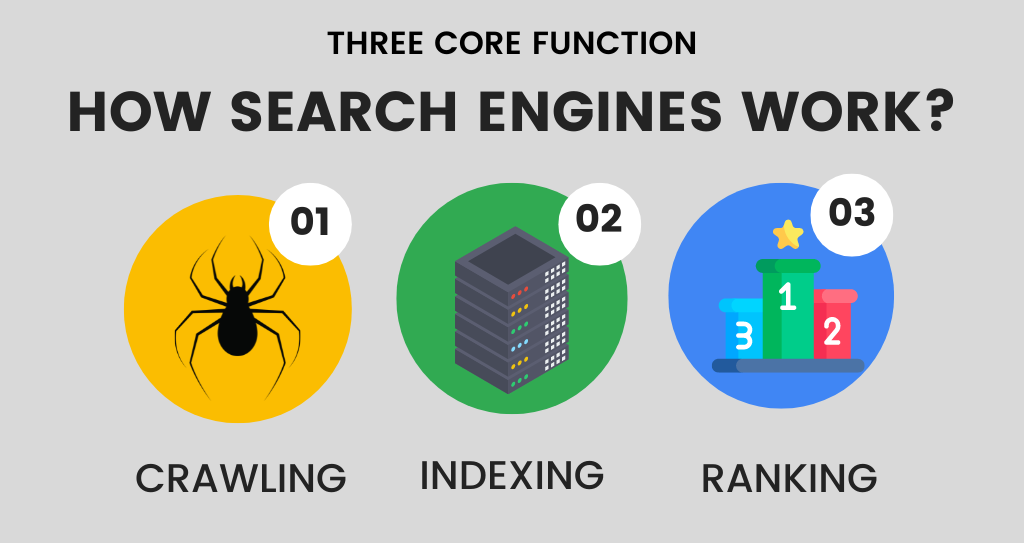
Most Important Question for SEO (Search Engine Optimisation) is to understand How Search Engine Works. So let’s Imagine you are in Mumbai which never sleeps. Every second, people are walking into lanes, asking for directions, recommending shops, warning friends, and shifting their trust from one place to another. That’s the internet. Search engines are just the city’s memory.
They don’t “think” like humans, but they observe us so closely that, over time, they start imitating how a society collectively decides: “Who should I go to for this problem?”
How society finds “the right person”:
In real life, when you need a lawyer, you don’t say, “Let me run a 200‑factor algorithm.” You do something very simple:
-
You ask a few trusted people.
-
You shortlist 2-3 names that sound relevant.
-
You notice who gets recommended again and again.
-
You talk to them and see who actually understands you.
Without writing it anywhere, your brain is doing a full ranking process.
Search engines do that with websites:
-
Crawling = “Who all exist in this city?”
-
Indexing = “Who does what, exactly?”
-
Ranking = “For this question, right now, who should I send this person to?”
The difference is: we do it for a few people around us; search engines do it for billions of pages and billions of searches.
Crawling: that one friend who “knows everyone”
In every city, there is always that one person who somehow knows every shop, every shortcut, every new café. “Arre, yeh naya restaurant khula hai, waha jaa ke dekh.”
Crawlers are that friend.
-
They move from one place to another through links – like going from one shop to the next through shared contacts.
-
A new website is like a new shop opening in a side lane; if nobody tells this friend (no links, no sitemaps), it stays invisible for a long time.
-
Busy, important markets (popular sites) get visited more often; deserted areas (dead or weak sites) are checked once in a while, or almost never.
If your server is slow, your pages keep breaking, or you’ve blocked search bots without realising it, you’re basically that shop with shutter half‑down and lights off. Even if you’re brilliant inside, the “friend who knows everyone” will assume you’re closed and move on.
Indexing: where people put you in their mental list
Once your friend knows your shop, she doesn’t just remember your address. She stores you in her head as: “This is the guy for X.”
Search does the same thing.
-
It reads your content, structure, links, images, everything and tries to answer: “What is this page actually about?”
-
It groups similar pages together: all the “home loan” pages in one mental folder, all the “SEO basics” pages in another.
-
When many versions of the same thing exist, it quietly chooses one as the “main” one (canonical) and treats others as duplicates.
-
If a page is thin, confused, or looks spammy, it’s like that person who says “Main sab karta hoon” but can’t talk properly about any one thing; you don’t trust them deeply.
Good indexing is not about keywords stuffed everywhere; it’s about being so clear that if someone hears you once, they never forget what you stand for.
Ranking: when two people need each other & in fast:
Now imagine a friend calls you:
“Yaar, I need a good cardiologist, urgently. Who should I go to?”
In that 10-20 second window, your brain does this:
-
Filters by relevance: “not a dentist, not a general physician, cardiologist only.”
-
Filters by location: “near his home or office, not the other side of the city.”
-
Filters by trust: “who is good, not just known?”
-
Filters by freshness: “who is actively practising, not retired?”
Search engines do the same thing for every query.
They look at:
-
Relevance: Does this page actually answer the question, in the right intent (learn / buy / compare / fix)?
-
Authority: Do other serious, relevant sites point to this one and essentially say, “Yeh banda sahi hai”?
-
Experience: When people go to this page, do they stay, read, scroll, click, or do they run back in 2 seconds?
-
Context: Where is the user? Which device? What language? What have they been searching for?
For the user, it looks like “10 blue links”. For the system, it’s a social decision:
Out of all the people who could speak on this topic, who is the safest, clearest, most trusted bet to connect right now?
Links, brand, behaviour: The gossip of the internet
Society runs on gossip and that can be good and bad. Someone doing great work without any talk around them grows slowly; someone constantly mentioned in the right circles becomes a default name.
Online, that gossip is visible as:
-
Backlinks: When a respected site links to you, it’s like a respected person saying, “Go to him.” The more relevant and trustworthy they are, the stronger the signal.
-
Brand searches: When people type your name + topic, it’s like your reputation spreading by word‑of‑mouth in the city.
-
Engagement: Dwell time, scroll, interaction – all of this tells the system, “People are not just visiting; they are sitting, talking, understanding.”
-
Negative feedback: Consistent bounces, bad experiences, spammy patterns – like everyone quietly saying, “Don’t go there, waste of time.”
You can fool one or two people with over‑promising, but if 1,000 people walk out unsatisfied, the reputation hits hard. Search engines are just listening to that pattern at scale.
What this asks from you as a site owner:
Once you see search as a social system, not a technical black box, your priorities simplify a lot.
You don’t wake up thinking “Which hack?”; you wake up thinking “How do I behave like the kind of expert society genuinely chooses?”
In practical terms:
-
Make it easy to find you: clean structure, sensible internal links, and no technical drama stopping crawlers at the gate.
-
Make it obvious what you stand for: one page, one core problem; clear language; deep enough to be taken seriously.
-
Earn genuine recommendations: content and work so useful that relevant sites feel comfortable sending their audience to you.
-
Respect people’s time and brain: fast pages, readable layout, honest promises, and answers that actually close the loop, not just chase clicks.
In the end, the question search engines are asking is the same question your ideal user is asking:
“If I send this person here, will they thank me later or feel cheated?”
If your content, product, and behaviour are strong enough that a human would proudly recommend you in real life, the algorithm usually follows.
The machine is only formalising what the crowd is already saying.