
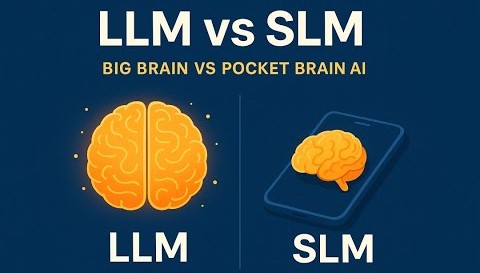
LLM vs. SLM: Who is Winning the Game?
LLM (Large Language Models) and SLM (Small Language Models) are two prominent players in the rapidly evolving field of artificial intelligence. As businesses and developers seek efficient AI solutions, the debate over which model type dominates intensifies. While LLMs like GPT-4 and Gemini boast vast capabilities, SLMs offer speed, cost-efficiency, and specialized performance. So, who is truly winning the game? Let’s break it down.
Understanding LLMs and SLMs
Before comparing the two, it’s essential to define what sets them apart.
What is an LLM?
LLM (Large Language Model) refers to AI models trained on massive datasets, often containing billions or even trillions of parameters. These models excel in general-purpose tasks, such as text generation, translation, and complex reasoning. Examples include OpenAI’s GPT-4, Google’s Gemini, and Meta’s LLaMA.
What is an SLM?
SLM (Small Language Model), on the other hand, is a more compact version with fewer parameters—typically in the millions or low billions. They are designed for efficiency, faster inference, and domain-specific applications. Microsoft’s Phi-3 and Google’s Gemma are notable SLMs gaining traction.
Performance: LLM vs. SLM
Strengths of LLMs
- Versatility – LLMs handle a broad range of tasks with high accuracy.
- Contextual Understanding – Their extensive training allows for deeper comprehension of nuanced queries.
- Few-Shot Learning – They can perform new tasks with minimal examples.
Strengths of SLMs
- Speed & Efficiency – SLMs process requests faster due to their smaller size.
- Lower Costs – Training and deploying SLMs require fewer computational resources.
- Specialization – They can be fine-tuned for niche applications like medical diagnostics or legal analysis.
The Battle: Who is Winning?
When LLMs Take the Lead
LLM dominance is clear in scenarios requiring broad knowledge and creativity. For instance:
- Content Creation – Writing long-form articles, scripts, or marketing copy.
- Complex Problem-Solving – Advanced coding, research, and data analysis.
- Multilingual Support – High-quality translations across numerous languages.
Where SLMs Outperform
SLMs shine in resource-constrained environments. Key advantages include:
- Edge Computing – Running on devices with limited processing power.
- Real-Time Applications – Chatbots, customer service, and quick data retrieval.
- Cost-Effective AI – Businesses with budget constraints benefit from SLMs.
Future Trends: Will One Dominate?
The AI landscape is shifting toward a hybrid approach. While LLMs remain the gold standard for general intelligence, SLMs are gaining ground in specialized and lightweight applications. Innovations like model distillation (compressing LLMs into SLMs) and federated learning (training models across decentralized data) suggest a future where both coexist.
Key Takeaways
- LLMs are best for complex, knowledge-intensive tasks.
- SLMs excel in speed, affordability, and customization.
- The winner depends on use cases—neither is universally superior.
Conclusion
The LLM vs. SLM debate isn’t about declaring a single winner but understanding their respective strengths. As AI evolves, we’ll likely see more collaboration between the two, with businesses leveraging each where they perform best. Whether you need the power of an LLM or the efficiency of an SLM, the key is choosing the right tool for the job.