
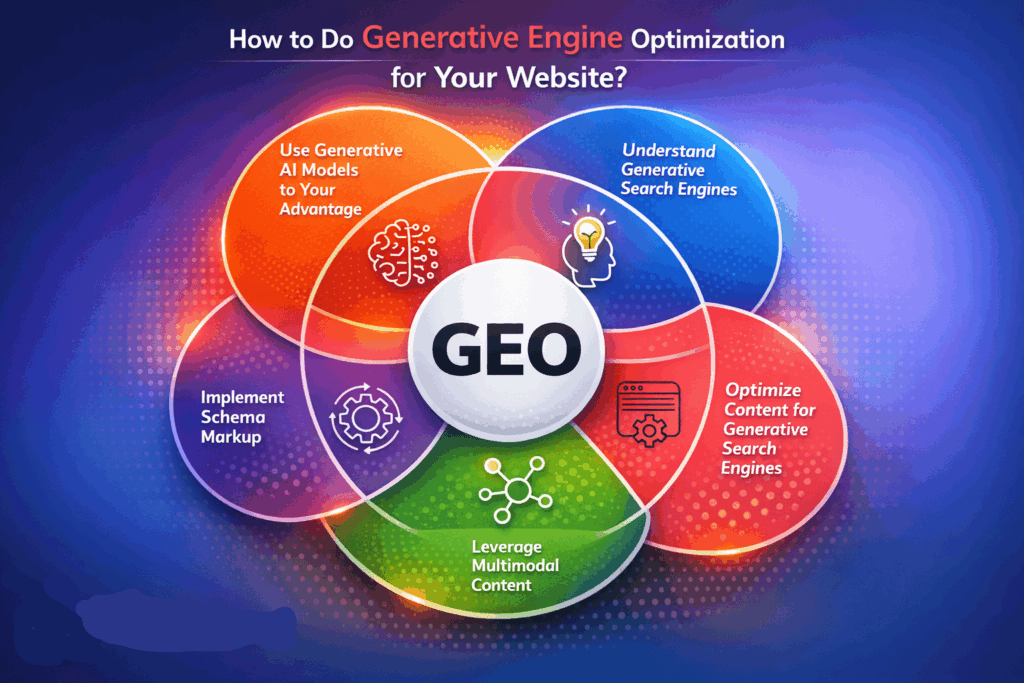
We all spent a decade learning “how to do SEO”. Then AI Overviews, Perplexity, ChatGPT Search and Gemini came in and suddenly half the industry started shouting new jargon: GEO (Generative Engine Optimization). SO Now What Is GEO? Let’s understand it in a Scaled Machine Decision Making system
Let’s be honest. Most of what people are calling GEO today is old SEO repackaged with some AI screenshots.
But there is a real shift happening.
And the best way to understand it – same as I did with SEO – is to map it to how decisions actually get made.
In my earlier old article I wrote:
“SEO is just scaled human decision-making.”
People search, click, read, stay, link, recommend and Google converts those millions of micro-decisions into rankings.
Now we’ve added one more layer on top:
GEO is just scaled machine decision-making.
Machines read your content, pick specific blocks, and stitch them into answers.
If SEO was “how do I become the obvious choice for humans?”
GEO is “how do I become the obvious ingredient for machines?”
Let’s break that down in plain language.
1. Quick recap: how SEO actually works (in real life)
Forget algorithms for a moment. Think like a user.
You search:
“best credit card for freelancers india”
What do you do?
- You scan 3-4 titles.
- You click one that looks specific, not generic.
- If the page is confusing, you bounce back in 3 seconds.
- If it’s good (clear benefits, fees, examples), you scroll, maybe bookmark or share.
- If it’s excellent, you might link it from your blog or recommend to a friend.
One person doing this is nothing.
Millions doing this every day = training data for Google.
Under the hood, SEO is:
- Engine retrieves candidates based on keywords + semantics.
- Humans vote with behavior (click, dwell, bounce, link).
- Algorithm learns patterns: which pages satisfy which intents.
- Rankings shift based on all this “human exhaust”.
That’s why I called SEO a scaled human decision system.
The engine is simply aggregating what people choose and don’t choose.
2. What changed with generative engines
Now add AI on top of this.
Earlier, the flow was:
query → list of 10 links → user chooses → visits your site
With generative engines, the flow became:
query → engine retrieves multiple pages → LLM reads chunks →
synthesizes one answer → shows that + a few citations
The user might never visit your site.
Example from fintech:
Someone asks Perplexity or ChatGPT Search:
“Which is better for me: home loan or loan against property for 50 lakh if my salary is 80k and I’m salaried?”
What does the engine do?
- It doesn’t care about your 2,000-word “What is LAP?” article as a whole.
- It pulls 10-20 relevant pages (maybe yours, maybe not).
- It cuts your content into small chunks (passages).
- It scans those chunks for clarity, safety, and specificity.
- Then it creates its own answer and maybe shows “pawneshwar.com” as one of 3-5 sources.
So the game changed from:
-
“Rank my page at position 1”
to:
-
“Make my passages so good that the model is almost forced to pick and quote them.”
That is the mindset of GEO.
3. GEO in one line: optimize for machine reading
Most SEO content was written for humans skimming on mobile.
We used to ask:
“Will a human understand this page quickly and feel we are trustworthy?”
Now there’s an extra question on top:
“Will a machine understand this paragraph quickly and feel it’s safe to reuse?”
Machines don’t “understand” like us.
They look at patterns:
- Is this block self-contained?
- Is the claim clear and not vague?
- Is there enough context to copy it without getting into trouble?
- Is this consistent with what other trusted sources say?
If yes → higher chance to be selected.
If no → the model picks another site.
So GEO is not about changing everything.
It’s about tuning your content to be machine-friendly at the passage level.
4. SEO vs GEO: what’s same, what’s new
Let’s keep it very practical.
4.1 What stays exactly the same
You still need:
- Proper technical SEO (crawlability, indexation, speed, schema).
- Solid topical coverage (clusters, depth on your niche).
- Real authority (links, mentions, trust signals).
If Google or Bing don’t even retrieve your page, no AI engine can magically cite you.
So yes, SEO fundamentals are non-negotiable.
GEO is not “instead of SEO”. It’s “on top of SEO”.
4.2 What actually changes with GEO
The real changes are here:
-
Unit of optimization: Page → Passage
-
Old mindset: “How do I rank this URL?”
-
New mindset: “How do I make this 2–3 paragraph block a perfect answer that can be copied as-is?”
-
-
Query shape: Keywords → Long conversational questions
-
Old: “personal loan for 10 lakh”
-
New: “how much personal loan can I get on 60k salary with 750 cibil and no other loan?”
-
-
Success metric: Rankings → Citations + brand presence in AI answers
-
Old: “I’m #1 for this keyword, traffic is up.”
-
New: “For this topic, how often do AI systems mention or cite my brand / URL?”
-
-
Optimization target: Human scanners → Machine + human together
-
You write in a way that’s simple for a model to parse, while still being engaging for people.
-
5. How machines “judge” your content (in simple terms)
Think of the LLM as a very fast, very strict editor.
It doesn’t read your entire blog carefully.
It looks at chunks and asks:
- What is this block about, exactly?
- Can I summarize or reuse it without confusion?
- Are there numbers/facts that make it useful?
- Does it look like expert talk or fluffy copy?
If your content forces the model to “guess”, it moves on.
If your content makes life easy, it uses you.
In my head, these are the 5 big GEO signals:
5.1 Atomic answers
One block = one clear idea.
Bad:
“Loans depend on many factors and you should carefully compare all banks…”
Good:
“With a CIBIL of 750 and ₹60k salary, most Indian banks will offer 10–13% interest on personal loans up to ₹10 lakh if you have no active EMIs.”
The second one is easy to quote.
5.2 Conversational, specific headings
Bad:
“Eligibility criteria”
Good:
“Who can get a home loan on 50k salary in India?”
This matches real queries users type into AI systems.
5.3 Step-by-step reasoning
LLMs love “If A then X, if B then Y” structures.
Example:
“Choose home loan if: 1) you’re buying a property, 2) LTV < 80%, 3) you need 20+ year tenure.
Choose LAP if: 1) property is already owned, 2) need cash for business, 3) okay with 12–15% interest.”
That’s reusable logic. The model can literally follow and rephrase it.
5.4 Clean data points
Instead of writing:
“We offer very competitive rates”
Write:
“Our average approved rate for salaried borrowers with 750+ CIBIL was 10.9% in Q1 2026.”
Concrete, timestamped, machine-friendly.
5.5 Named frameworks
You already think in frameworks. Just name them.
Example:
“Pawneshwar’s 3-Filter Loan Fit Model:
- Affordability (EMI/Income),
- Flexibility (prepayment rules),
- Fragility (how badly a bad month will hurt you).”
Now, when an AI engine wants to explain “how to choose a loan”, your named model becomes a neat block it can reuse and attribute.
6. Simple GEO framework you can apply today
If I had to explain GEO to a junior marketer on my team, I’d give this 4-step play.
Step 1: Start with your existing SEO winners
- Take top 20 pages already getting organic traffic.
- For each, write down 5–10 real questions your user is trying to answer.
- Then literally ask those questions in Perplexity / ChatGPT Search / Gemini and see:
- Do you appear in sources?
- Does the answer “sound” like your content or someone else’s?
This gives you a baseline.
Step 2: Turn key sections into “answer blocks”
Pick one article, for example “personal loan eligibility”.
Rewrite one section like this:
- Clear H2 matching a full question:
“How much personal loan can I get on 60k salary in India?” - 2–3 tight paragraphs with: ranges, examples, and if/then guidance.
- Optional: a micro-table or bulleted decision rule.
You’ve just created a GEO-ready chunk.
Step 3: Add structure machines love
- Use FAQ schema where relevant.
- Use bullets for steps, not long messy paragraphs.
- Make sure each sub-heading section can stand alone if someone screenshots it.
Step 4: Track new metrics
Along with normal SEO KPIs, start watching:
- How often AI tools show your domain as a source.
- How often your framings or ranges show up, even if not linked.
- Branded search growth after your topic starts getting more AI visibility.
This tells you if your influence is growing, not just traffic.
7. So, is GEO really new?
My honest view as a digital marketer:
- 60-70% of GEO is just good SEO + good content thinking with a new UX on top.
- The remaining 30-40% is genuinely new:
- Passage-level optimization.
- Writing for machine readers.
- Measuring citations/mentions instead of only clicks.
If you ignore GEO completely, you’ll still get some visibility from your SEO work.
But you’ll miss a growing surface where people consume answers without visiting your site.
For me, the goal is simple:
Be so clear, so useful, and so structured that both humans and machines
independently decide, “Let’s use Pawneshwar’s answer.”
That’s GEO.